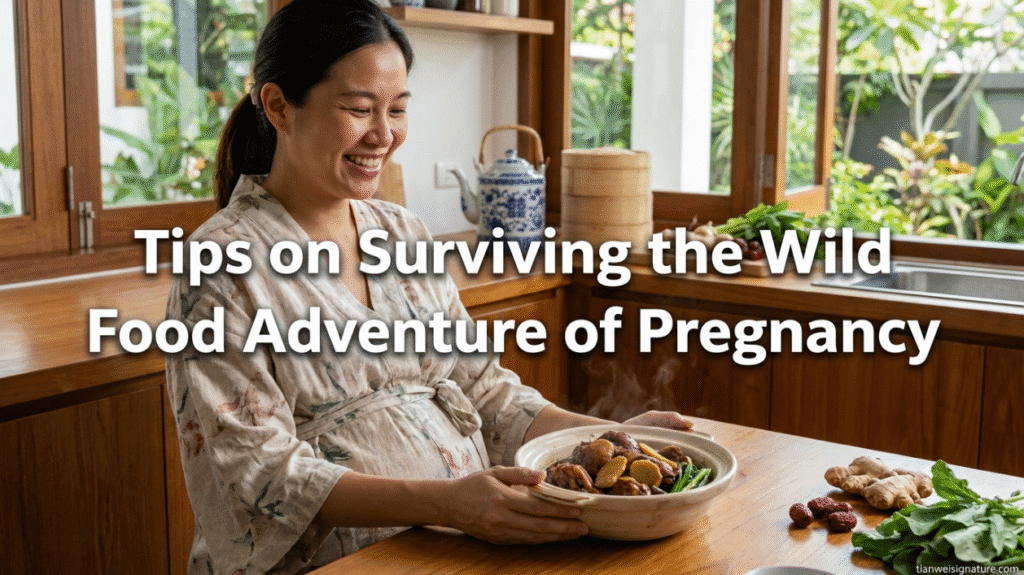
Pregnancy eating can feel like a constant tug-of-war between what you fancy right now and what you are “allowed” to eat. If you have ever stood in a supermarket aisle craving sushi, eyeing a cold deli sandwich, and negotiating with your nausea all at once, welcome to the wild food adventure of pregnancy.
The good news is you do not need a perfect diet to do a great job. You need a few solid safety rules, a simple plan for key nutrients, and some realistic strategies for cravings and aversions, especially when life (and hormones) get loud.
By the time you are nearing delivery, the adventure also starts to overlap with a very Singapore-specific question: what will you eat during confinement, and who will cook it when you are exhausted?
Tips on Surviving the Wild Food Adventure of Pregnancy
1) Start with the “big three” goals: safety, nutrients, and sanity
Instead of memorising a hundred dos and don’ts, use this quick framework:
- Safety first (avoid the highest-risk foods for foodborne illness).
- Nutrients next (focus on folate, iron, iodine, choline, calcium, vitamin D, fibre, and protein).
- Sanity always (make it doable on busy days and low-energy weeks).
Many pregnant women are advised to aim for a colourful mix across all five food groups, while limiting added sugars, saturated fat, and sodium. If your appetite is unpredictable, consistency matters less than your overall pattern across the week.
2) Know the real “boss-level” food safety risks
A lot of pregnancy food rules are about avoiding infections that can be mild for you, but risky for the baby.
Listeria is a key one. Pregnant women are about 10 times more likely to get listeriosis than other healthy adults, and pregnancy-associated cases make up a meaningful share of total cases. That is why guidelines are stricter around ready-to-eat chilled foods.
Toxoplasma is another concern. It is associated with raw or undercooked meat, unwashed produce, contaminated water, soil, and cat litter exposure, and a large proportion of pregnant women are considered at risk due to environmental and dietary pathways.
Here is a practical “swap list” you can save:
| If you’re craving… | Approach with caution | Choose this instead |
| Deli meat sandwiches | Cold deli meats (unless reheated until steaming hot) | Freshly cooked chicken slices, or heat the filling thoroughly |
| Soft cheeses | Unpasteurised dairy | Pasteurised dairy and clearly labelled cheeses |
| Sushi | Raw seafood | Cooked sushi options, or low-mercury cooked fish |
| Rare steak or “just a taste” | Undercooked meat | Cook meat thoroughly and avoid sampling before it’s done |
| Pre-cut fruit, salads, chilled pâté | Ready-to-eat chilled items | Wash whole produce yourself, choose freshly prepared hot foods |
At home, the basics still work brilliantly: wash hands, separate raw and cooked foods, clean boards and knives, and cook meat thoroughly.
3) Fish is not the enemy: choose low-mercury options
It is common to hear “avoid fish” in pregnancy, but many health authorities now encourage eating a variety of lower-mercury seafood because it supports baby’s brain and eye development.
A widely used guideline is 8 to 12 ounces of low-mercury seafood per week. Practical go-to options include salmon, prawns, pollock, catfish, and canned light tuna, while high-mercury fish (such as shark and swordfish) are best avoided.
If fish suddenly smells unbearable, that is also normal. Try alternatives like eggs, tofu, beans, and lean meats for protein, and revisit fish later in pregnancy if aversions ease.
4) Your “power-up nutrients” checklist (without turning meals into homework)
If you are overwhelmed, pick one or two focus areas each week:
- Folate and folic acid: Recommendations commonly sit around 400 micrograms daily pre-pregnancy and about 600 micrograms daily during pregnancy. Food sources include leafy greens, beans, and fortified grains.
- Iron: Found in lean red meat, poultry, legumes, tofu, and spinach. Pair plant sources with foods that contain Vitamin C (like guava or citrus) to support absorption.
- Iodine and choline: Often overlooked. Eggs, dairy, and seafood can help.
- Calcium and vitamin D: Dairy, calcium-set tofu, and fortified foods can contribute. Adults are commonly advised around 1,000 mg calcium daily, depending on individual needs.
- Fibre and fluids: Helpful for constipation, which is common in pregnancy. Fruits, vegetables, oats, and brown rice can make a difference.
If supplements are part of your plan, confirm what is right for you with your obstetric team, especially if you have anaemia, thyroid conditions, or dietary restrictions.
5) Cravings and aversions: how to cope without guilt
Cravings are extremely common. Estimates suggest 50 to 90 percent of pregnant women experience them, often starting in the first trimester. Aversions can be just as powerful, especially with nausea and heightened smell.
Try these low-drama tactics:
- Use the “pairing” rule: if you want chips, pair with yoghurt or a boiled egg. If you want something sweet, pair it with nuts or milk.
- Shrink the decision: buy single portions so you can satisfy the craving without turning it into an all-day snackathon.
- Make peace with phases: some weeks you can only handle plain carbs. That is not failure, it is symptom management.
- Watch for pica: cravings for non-food items (like ice, clay, or starch) need medical attention, as they can signal deficiencies and carry risks.
If vomiting, reflux, or food avoidance is severe, bring it up early with your clinician. You deserve support, not “just tolerate it” advice.
6) Myth-busting that saves you stress (and group chat arguments)
Myth: Eating for two means doubling portions.
Reality: Nutrient needs rise more than calorie needs, especially early on. Focus on food quality and regular meals.
Myth: All soft cheese is banned.
Reality: Pasteurised dairy is generally considered safer. The main risk is unpasteurised products.
Myth: Cravings predict baby’s sex.
Reality: There is no solid evidence that sweet versus savoury cravings reliably indicate baby’s sex.
Myth: If you feel fine, food poisoning is not a worry.
Reality: Some infections can be mild in the pregnant person but still harmful in pregnancy, so prevention matters.
7) The pregnancy-to-confinement bridge: plan before you are too tired to plan
In Singapore, many parents start researching the best food for confinement while still pregnant, because once a baby arrives, decision-making becomes harder.
A common question is: is confinement food necessary? You do not have to follow any single “perfect” tradition, but many families find a structured meal plan helpful because it:
- reduces stress when you are healing and sleep-deprived
- supports regular eating when your hands are full
- helps partners and grandparents worry less about what you “should” be eating
For first-time parents, or anyone with no one to cook at home, this is where a reliable meal service can feel like a lifeline rather than a luxury.
If you want to get a feel for what modern confinement meals can look like, you can browse sample dishes and combinations here.
8) What makes Tian Wei practical for real postpartum life
Confinement food should be comforting, but it also has to be enjoyable enough to eat day after day.
Tian Wei is built around variety, including Traditional Chinese dishes and, from Week 2 onwards, fusion options that keep your appetite interested. Think Coq Au Vin, Seared Salmon with Cauliflower Cream, and Braised Pork Trotter in Black Vinegar, alongside familiar staples.
A few brand details parents in SG often care about:
- Breastfeeding-friendly approach: we use garlic, ginger, fenugreek, and green papaya to support breast milk supply.
- Herbal soups: reviewed by Ma Kuang TCM
- Service flexibility: book now and activate later, with two daily deliveries (lunch and dinner) served fresh.
If you are already mapping your postpartum support system, you can check availability and plan ahead here.
9) Your simple survival plan (save this)
If you want a one-screen checklist for the rest of pregnancy:
- Keep key safe “defaults” at home: eggs, yoghurt, oats, fruit, nuts, cooked proteins, and washed vegetables.
- Follow the big safety rules: avoid unpasteurised dairy, avoid undercooked meat, reheat deli meats until steaming hot, and wash produce well.
- Aim for colour and protein at most meals, even if portions are small.
- Give cravings a role, not the steering wheel: satisfy, then balance.
- Start confinement planning early, especially if cooking support is uncertain.
There is no single way to “win” the Wild Food Adventure of Pregnancy. You are looking for safe, nourishing, realistic meals that work on your hardest days, not just your best days. When you are ready to lock in your postpartum food plan, Book Now. Book 1 month before your EDD and enjoy an early bird discount.