
Ancient Origins of Chess Sets
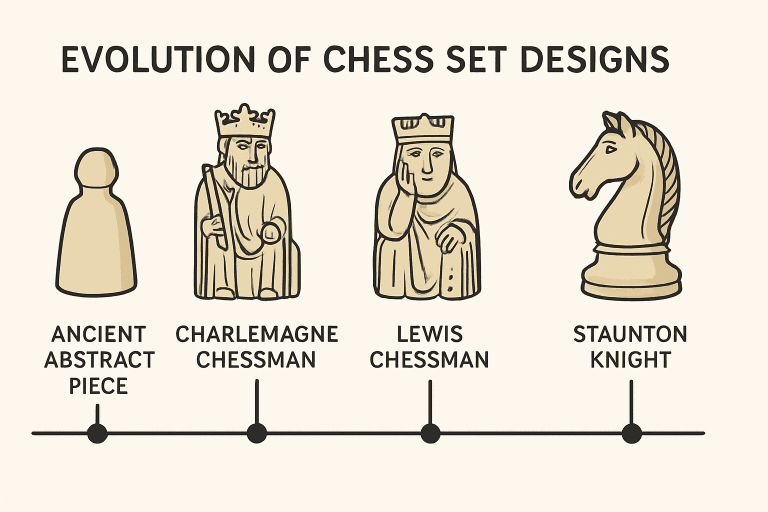
The fascinating journey of chess sets begins in ancient India, where early chess pieces were minimal and void of decoration. These representations prioritized the game’s strategic essence over any aesthetic ambition. Over the centuries, as the game spread into new regions, its designs began to reflect the customs, religious beliefs, and artistic sensibilities of various peoples.
As chess spread along trade routes through Persia, the Islamic world, and into Europe, the transformation of chess pieces mirrored the evolving cultures. During the Middle Ages, elaborate sets started to replace earlier abstract forms. For those passionate about antique and renaissance chess sets, the story of their evolution offers a window into different societies’ artistry.
Chess pieces have undergone continual adaptation, moving from anonymous tokens to meaningful figures representing royalty, soldiers, and bishops. This cultural diffusion is not only recorded in museum exhibits but also in artifacts from archaeological digs. These findings underscore the way chess has united diverse communities through shared strategy and design.
In many regions, chess pieces have become cherished objects of material culture, their stylistic differences often hinting at the circumstances of their creation. For instance, pieces unearthed from ancient Persia were influenced by Islamic art, emphasizing geometric patterns over figural representations.
Medieval Masterpieces: The Charlemagne and Lewis Chessmen
By the medieval era, chess sets had evolved into true artistic treasures. The Charlemagne chessmen, now housed in the Cabinet des Médailles in Paris, epitomize the splendor of the High Middle Ages. These ivory pieces, believed to be crafted in the 11th century, display remarkable detail and attest to chess’s status as a game for Europe’s elite.
Equally celebrated are the Lewis chessmen, carved from walrus ivory and dating to the 12th century. Discovered on Scotland’s Isle of Lewis, these pieces are distinguished by their expressive, almost whimsical faces and unique forms. Scholars suggest that the creators combined Norse and Celtic artistic elements, making the Lewis chessmen invaluable to historians and chess enthusiasts alike.
Both the Charlemagne and Lewis sets symbolize how chess transcended pure entertainment to become instruments of cultural exchange. Their intricate carvings reflect not only regional traditions but also the social significance attached to the game in medieval Europe.
The medieval masterpieces demonstrate a shift in how chess was perceived, from a mental contest to a subject for artistic exploration and a symbol of prestige among the upper classes.
The Staunton Standard: A 19th-Century Revolution
The 19th century saw a turning point in the development of chess sets with the advent of the Staunton design, which remains the gold standard for competitive play. Named after Howard Staunton, a renowned English chess player, this pattern was registered in 1849 by Nathaniel Cook and quickly adopted due to its clarity, stability, and balanced proportions. The Staunton set marked a move away from the eccentricity of earlier designs, providing easily recognizable pieces that made tournaments fairer and more accessible.
The Staunton set became the benchmark for international competitions, thanks in part to increased regulation of the game during the 19th century. Its influence persists in every major tournament, making it arguably the world’s most universally recognized chess set.
Cultural Variations in Chess Set Design
Though the Staunton standard dominates competitive chess, local traditions and materials have given rise to extraordinary diversity in chess set production worldwide. For example, the Makonde chess sets of East Africa are carved from timber and incorporate motifs unique to Makonde culture, often transforming the chessboard into an animated scene of dancers, animals, and mythological figures.
Elsewhere, Russian chess sets frequently pay homage to folklore and national history, while Indian artisans have produced elaborate sets from sandalwood and ivory for centuries. Each variation tells a different story, serving both as game equipment and beautiful, collectible art. Intricate Chinese sets might feature warriors and scholars reflecting ancient traditions, while European travel sets revealed the social importance of chess among the nobility.
The cultural versatility of chess sets shows how the game has adapted to meld with local values, craftsmanship, and artistic movements. International museums and private collections brim with examples that illustrate how chess has continually adapted to reflect the tastes and values of diverse communities.
Modern Collections and Exhibitions
Today, the evolution of chess sets is honored in exhibitions and collections around the world. The World Chess Hall of Fame in St. Louis stands as a testament to chess’s lasting impact, offering interactive displays and rotating exhibits that explore the art and history of chess sets. Visitors can view a spectrum of designs and materials, gaining insight into the creativity that continues to fuel the craft.
Globally, interest has only intensified with the popularity of televised tournaments and online chess platforms. Museums and collectors increasingly focus on rare and thematic sets, from Art Nouveau interpretations to contemporary abstract models.
Modern collections curate not just the pieces themselves, but also stories of the world’s best players and the societies that embraced chess. The ongoing curation and celebration of these sets inspire new generations of players and artists to appreciate the game’s visual dimension as much as its intellectual challenge.
Final Thoughts
The history of chess sets, from ancient abstract forms to ornate medieval masterpieces and contemporary collections, is a chronicle of human ingenuity, cultural exchange, and artistic achievement. Each set, whether unearthed from a medieval tomb or displayed in a modern museum, provides a tangible connection to the people and eras that gave the game its universal appeal. As the global love of chess continues to thrive, chess sets will remain enduring symbols of creativity and civilization.